New Picnic Tables At Parade Grounds
Picnic tables sit on concrete pads built for Ft. Wright. FIConservancy photos
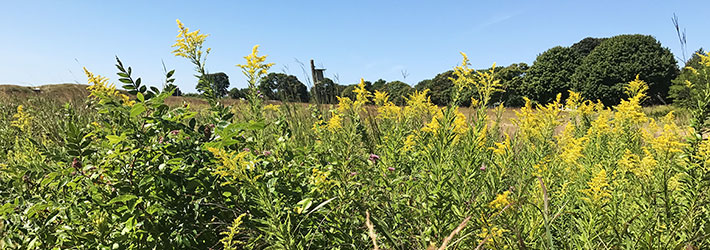
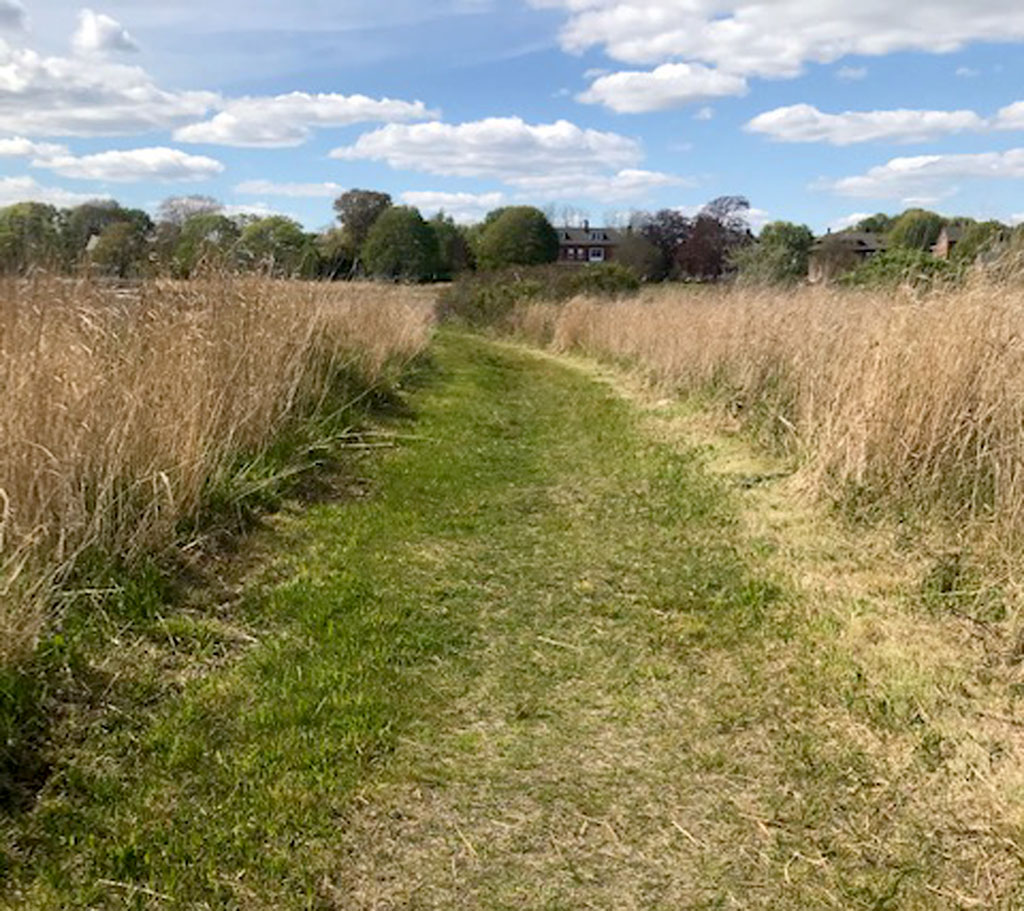
Come to the Parade Grounds! The stage is set for fun family picnics amidst ocean breezes and serene meadows. FIConservancy has installed four picnic tables in the Parade Grounds to enhance the enjoyment of 175 acres of Fishers Island’s restored grasslands.
Three tables, one set for a picnic, sit at west end of Parade Grounds. The fourth picnic table is near final stop of Par Course, also at the west end.
VERY IMPORTANT: Please bring post-picnic trash bags to leave the sites as pristine as you found them.
How to Get There
(l) Access three picnic tables from concrete road. (r) Access fourth picnic table from par course.
Drive past Transfer Station. Park just past concrete road. Three picnic tables are 300 feet up the paved road on the left. To reach fourth picnic table, enter path to Par Course. Follow course to final stop. South Beach is just a short walk from parking area.
(Sent as eBlast July 22, 2020)
President’s Message: 2020
As I watch Northern Harriers, Red-tailed Hawks and Kestrels hover over beaches and meadows, I am reassured that once again, the fanfare of spring has arrived, transforming our Island into a glorious oasis.
The Fishers Island Conservancy (FIConservancy) has been an important partner in sustaining and enhancing this delicate ecosystem with ongoing stewardship and oversight. As we celebrate 35 years of supporting the island, we find ourselves facing unforeseen challenges that require a new approach to outreach and planning.
Our primary concern is the safety and welfare of the entire Fishers Island community. With that in mind, we have canceled “Sunset on the Beach” for 2020. This will significantly impact our fundraising goals. But we are already looking forward to July 17, 2021, when we will continue this great and much-anticipated tradition. We remain committed to providing family-centered (and socially distanced) events as we move through the summer, including Nature Days in August and a showing of the movie Big Little Farm.
Our ongoing projects continue at full throttle, such as this year’s Audubon-structured migratory bird count May 2, when we happily counted 44 different species, despite our masks and gloves. Also, our partnership with FIDCO is on track as we renew badly-damaged micro-environments at targeted spots around the island.
Other active FIConservancy initiatives include guiding students in our Island Sentinels program, partnering with off-island organizations to lobby for environmental best practices, sponsoring the pump out boat in West Harbor, and allocating grants, one of which recently led a Fishers Island School student to first place in a prestigious science fair.
One aspect of life that COVID-19 can’t change is the magnificent beauty this island affords its residents. It’s more important than ever to take time to appreciate the enduring gifts that nature bestows on this small corner of the world. Take a moment to stroll through the Parade Grounds during a summer sunset or sit in the John Thatcher Native Garden (formerly the Demonstration Garden) and watch the local birds take wing. We will be providing socially distanced picnic tables beneath the black gum trees to enhance your enjoyment.
Please know that FIConservancy is still working hard to sustain and enhance our island’s natural resources, even though we are battling a significant reduction in our fundraising dollars. We deeply appreciate any donations you can give to help cover the shortfall due to the loss of “Sunset On the Beach.” A donation to the FIConservancy is a donation to Fishers Island.
Many thanks and please stay safe and healthy.
For the Conservancy,
Tom Sargent, President
Eight birdwatchers observed 45 species in the Spring 2020 Migratory Bird Count May 2 under cloudy skies with cool temperatures in the low 50s F. The group donned masks and practiced social distancing as they proceeded through Audubon’s required 15 five-minute stops across the Island.
“We saw a sedge wren in a pond before the Big Club,” said Tom Sargent, group leader and president of FIConservancy. “Those birds like cattails, which have been obliterated by phragmites, so we did not expect to see this bird.
“But just at the end of the area, we found a few cattails left, and that’s where we saw the wren. Phragmites are so thick that birds cannot nest and therefore cannot breed there. This shows the importance of habitat.”
Migration may have been slow due to a chilly April, because the count was down from the past two years. There were 56 species counted in spring 2019, 55 species in spring 2018 and 45 species in spring 2017.
Stayed tuned for the 2020 Fall Migratory Bird Count in September. There were 45 species noted for the Fall 2019 count.
Kristen Peterson Photos
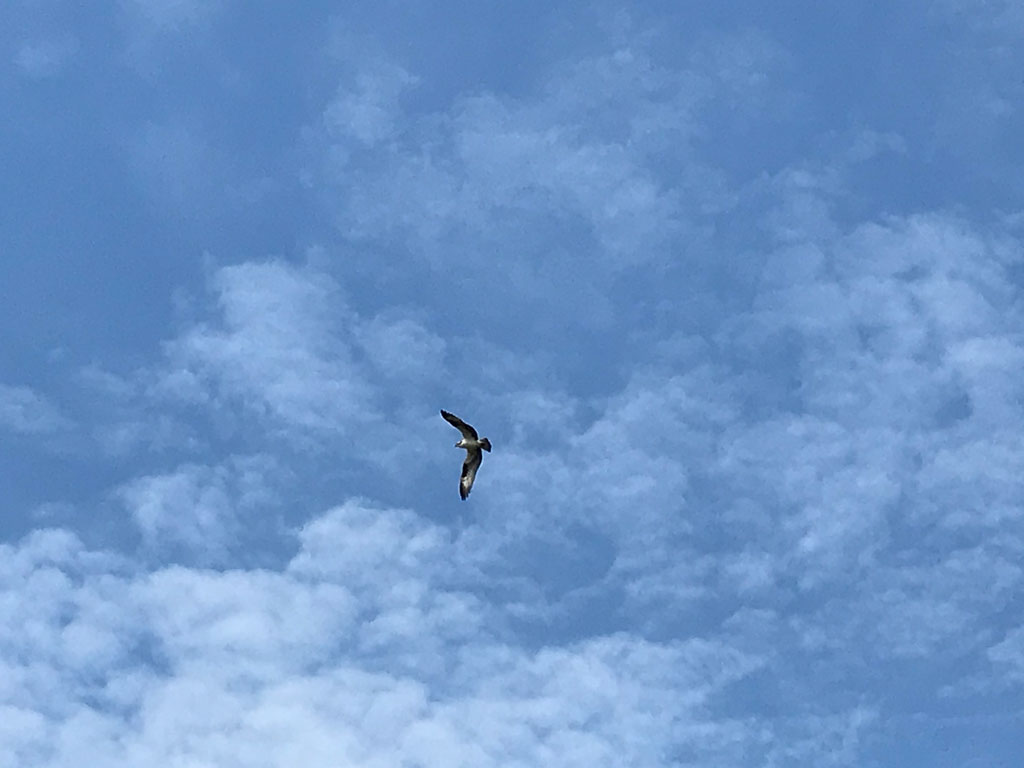
An osprey soars above Fishers Island’s birdwatchers.
Tons of marine debris on Fishers Island beaches and shoreline provide a never-ending clean-up challenge for FIConservancy employee Michele Klimczak. Michele Klimczak Photo
Memorial Day brings the official start to our Fishers Island summer. Help us maintain a clean and healthy environment on Fishers Island: Please grab a bag and pick up debris that you see on or near our beaches and coastline.
In 2019, Island resident Michele Klimczak collected an astounding 8,441 pounds of marine debris from the shores of Fishers Island.
FIConservancy employs Michele to patrol multiple Island locations (listed below) and clear away marine debris. For example, in just one day (Feb. 20, 2019), Michele collected 49 lbs. of debris at the Hay Harbor Club Beach:
Approximately 35 plastic bags sticking out of low tide sand, plastic cups, silverware, containers, bottles, pens, straws, drink stirrers, frisbee, flip flop, mylar and rubber balloons, balloon ribbon, fishing line, string, rope pieces, broken toys, bottle caps, cans, netting, pail. Two large plastic pieces, hose/tubing, wire, broken styrofoam and cups, food containers, food/snack/candy wrappers, full bag of green beans, cigar tips, tampon applicators, drink cup lids, plastic gallon jugs.
Thank you for joining in our mission to help preserve and enhance Fishers Island’s natural resources and surrounding waters. Together, we can help protect the future of our beautiful island!
Locations of FIConservancy Marine Debris Collection:
Latimer Light beach, Clay Point Road beaches, Dock Beach, South Beach, Sanctuary of Sands near South Beach, Race Point beaches, Elizabeth Airport beaches, Silver Eel Cove, Little Stony beach, beaches behind Money Pond, Chocomount Beach, Chocomount Cove, South Dumpling beaches, Isabella Beach, beaches before Big Club, Grey Gulls, Holiday House beaches, Houghton beach, beach at bottom of Four Corners road, beach at stables, beaches to left of Castle Road, Hay Harbor Club beach. (Sent as blast May 26, 2020.)
Native or Non-Native Praying Mantis? All Three Live on Fishers Island
Left: Carolina Mantis (native); Middle: European Mantis (non-native); Right: Chinese Mantis (non-native), Dianne Crary Photo
True or false: It is illegal to kill a praying mantis. False. In spite of this erroneous myth, it is not a good idea to kill a praying mantis on Fishers Island, since both native and non-native species live here, and it is important to know the difference.
The invasive Chinese praying mantis is the largest mantis in North America and the most visible mantis on Fishers Island. It can grow to over four inches. Mantises are formidable predators. They eat everything they can subdue and do not distinguish between harmful or beneficial insects, preying on bees, ladybugs, moths, spiders, crickets, grasshoppers, as well as frogs, lizards, snakes and even birds. Ruby-throated hummingbirds are their favored bird target, but mantises will also go after warblers, sunbirds, honeyeaters, flycatchers and vireos.
The female praying mantis is a voracious eater and is known to attack and eat the smaller male while mating. Some scientists think that this activity is exaggerated, as it happens more frequently in a laboratory than in the wild. The female dies after laying eggs, which will hatch in the spring.
Mantises can turn their heads 180 degrees to scan their surroundings with two large compound eyes and three simple eyes. They are efficient and ruthless hunters. In May, a graphic video went viral, showing a praying mantis chewing through the entire head of a so-called Asian “murder” hornet.
The praying mantis is named for its prominent (and powerful) front legs, which are bent and held together at an angle that suggests the position of prayer. Their closest relatives are termites and cockroaches. Unfortunately, egg cases of Chinese praying mantises are available on the Internet as an “organic” way of controlling insect garden pests.
FIConservancy President Tom Sargent addresses a crowd at “Sunset on the Beach” 2019. This popular event has been postponed until 2021 in the interest of the health and safety of the Fishers Island community during this pandemic.
Dear Fellow Fishers Islander,
As I watch Northern Harriers, Red-tailed Hawks and Kestrels hover over beaches and meadows, I am reassured that once again, the fanfare of spring has arrived, transforming our island into a glorious oasis. The Fishers Island Conservancy (FIConservancy) has been an important partner in sustaining and enhancing this delicate ecosystem with ongoing stewardship and oversight. As we celebrate 35 years of supporting the island, we find ourselves facing unforeseen challenges that require a new approach to outreach and planning.
Our primary concern is the safety and welfare of the entire Fishers Island community. With that in mind, we have canceled “Sunset on the Beach” for 2020. This will significantly impact our fundraising goals. But we are already looking forward to July 17, 2021, when we will continue this great and much-anticipated tradition. We remain committed to providing family-centered (and socially distanced) events as we move through the summer, including Nature Days in August and a showing of the movie Big Little Farm.
Our ongoing projects continue at full throttle, such as this year’s Audubon-structured migratory bird count May 2, when we happily counted 44 different species, despite our masks and gloves. Also, our partnership with FIDCO is on track as we renew badly-damaged micro-environments at targeted spots around the island.
Other active FIConservancy initiatives include guiding students in our Island Sentinels program, partnering with off-island organizations to lobby for environmental best practices, sponsoring the pump out boat in West Harbor, and allocating grants, one of which recently led a Fishers Island School student to first place in a prestigious science fair.
One aspect of life that COVID-19 can’t change is the magnificent beauty this island affords its residents. It’s more important than ever to take time to appreciate the enduring gifts that nature bestows on this small corner of the world. Take a moment to stroll through the Parade Grounds during a summer sunset or sit in the John Thatcher Native Garden (formerly the Demonstration Garden) and watch the local birds take wing. We will be providing socially distanced picnic tables beneath the black gum trees to enhance your enjoyment.
Please know that FIConservancy is still working hard to sustain and enhance our island’s natural resources, even though we are battling a significant reduction in our fundraising dollars. We deeply appreciate any donations you can give to help cover the shortfall due to the loss of “Sunset On the Beach.” A donation to the FIConservancy is a donation to Fishers Island.
Many thanks and please stay safe and healthy.
Cheers
Tom
Thomas A. Sargent
President
Fishers Island Conservancy
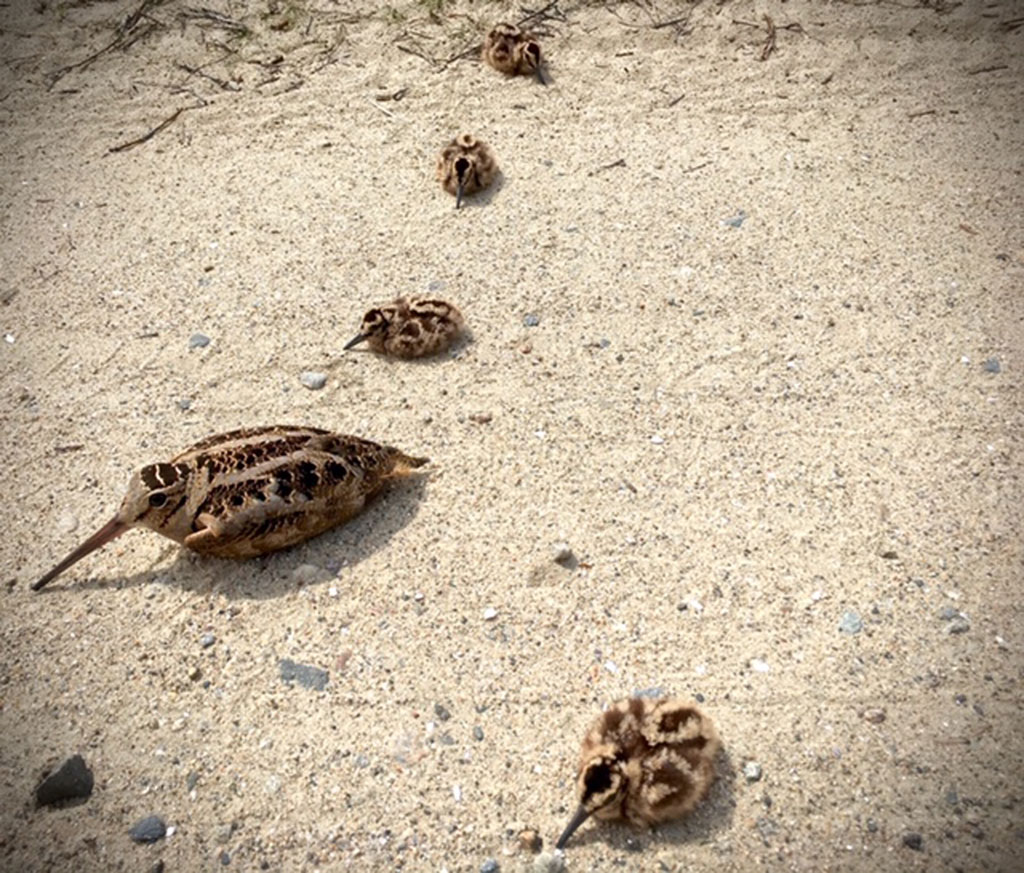
First sighting of breeding American woodcock on Fishers Island in many years. Kyle Kibbe Photo
The American woodcock is neither endangered nor globally threatened. Island residents have reported seeing woodcocks in the Parade Grounds, and its song was documented in the Parade Grounds during the 2018 spring migration.
The exciting news, however, is that this is the first example of a breeding pair on Fishers Island for some time. These birds were spotted April 11 near South Beach. They have clearly benefited from ongoing grassland restoration in the Parade Grounds, Elizabeth Airport, Race Point and South Beach.
Although classified with sandpipers as shorebirds, American woodcock spend most of their time hidden in fields and on the forest floor probing for earthworms where the soil is moist.
The population of the American woodcock has fallen by an average of slightly more than 1% annually since the 1960s. Most authorities attribute this decline to a loss of habitat caused by forest maturation and urban development.
There are many colorful folk names for the American woodcock. These include timberdoodle, bogsucker, night partridge, brush snipe, hokumpoke, twitterpate, little gomer, fiddle squeak, worm sabre, wafflebird, bumblebee chicken, mud needle, prairie turtle, and crazy straw.
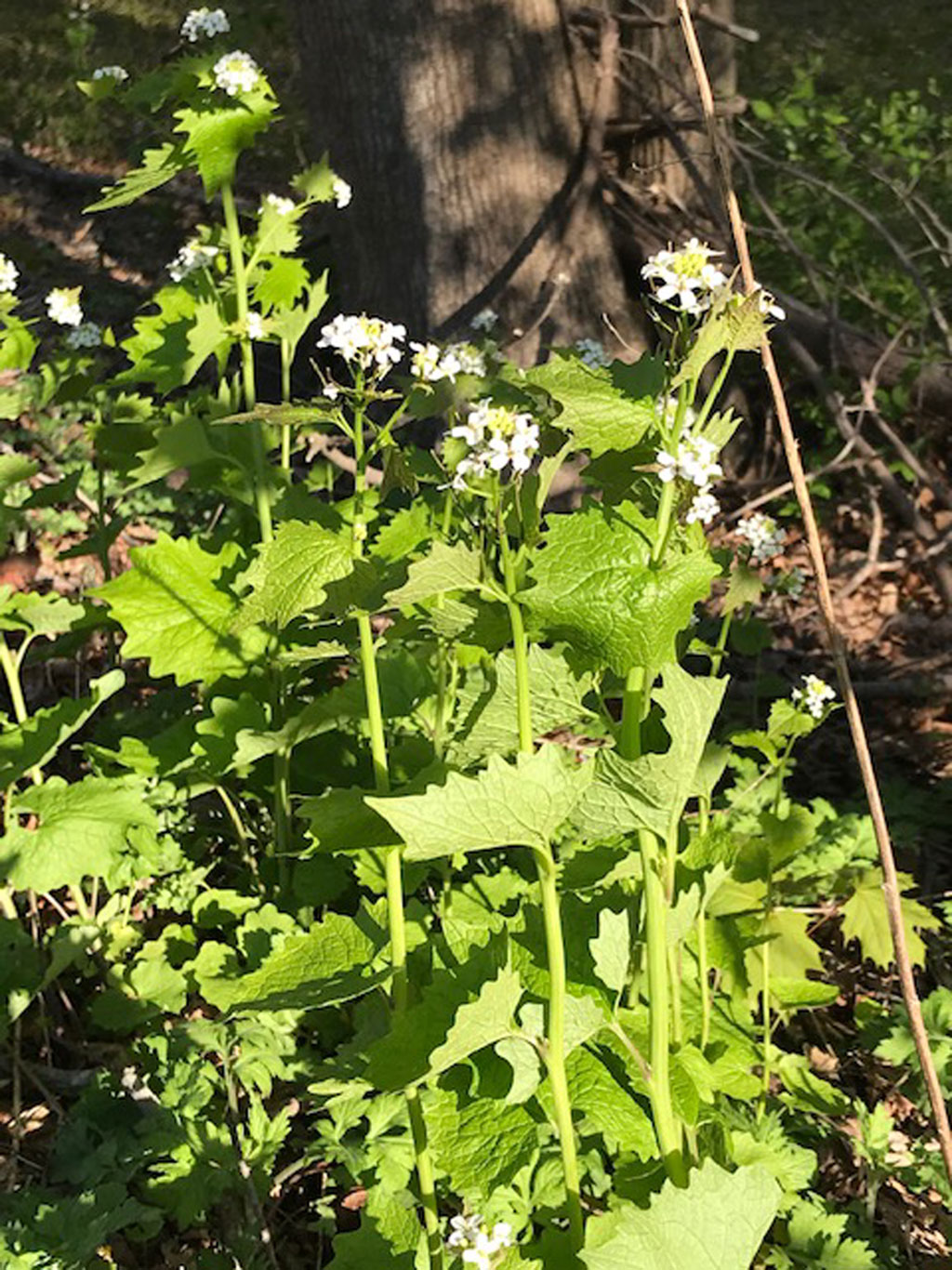
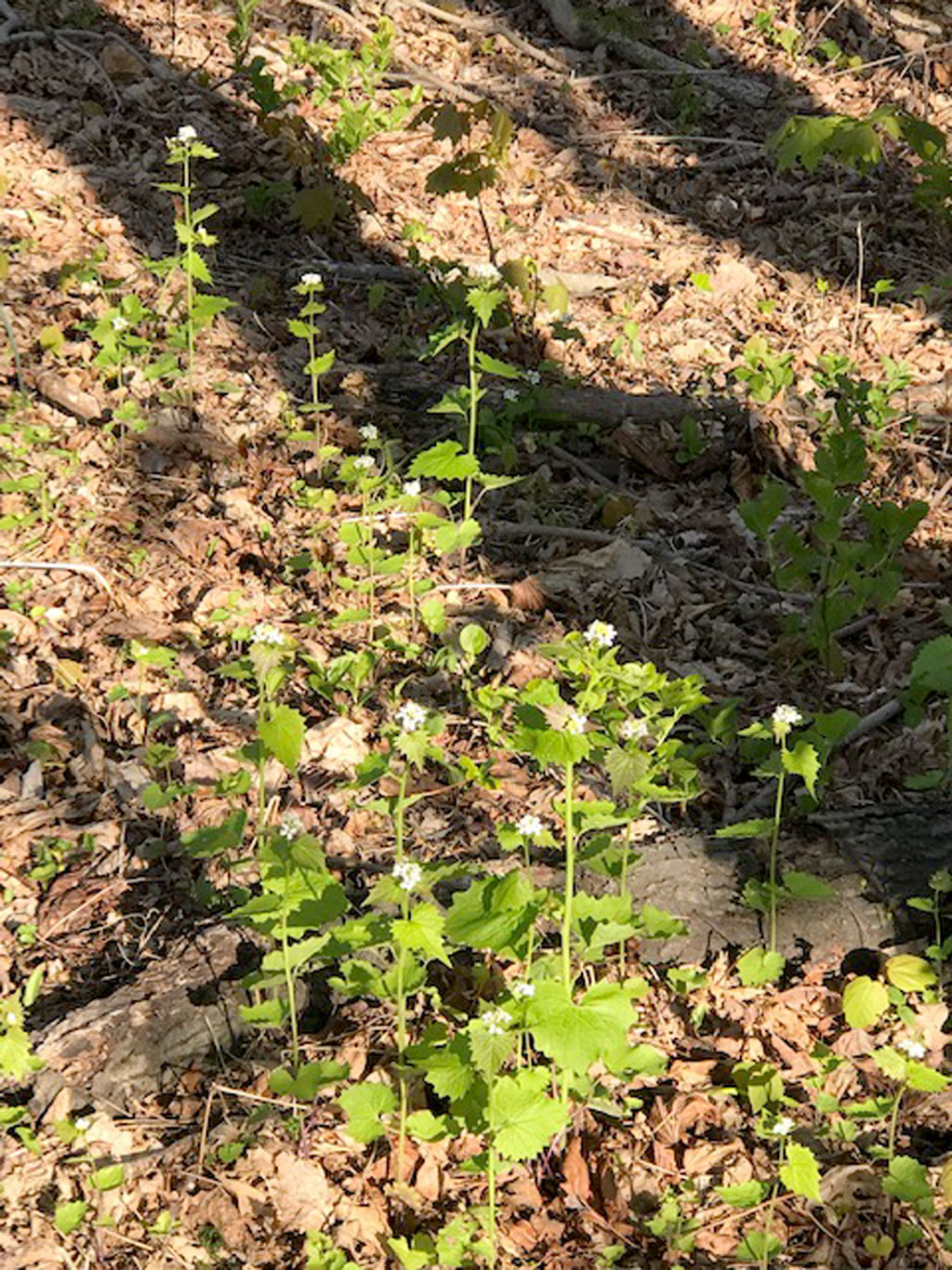
Garlic mustard invasive plant. Tom Sargent Photo
Fishers Island is awash in mustard garlic. This plant is a tenacious invasive weed that exudes a chemical through its roots that inhibits native plants from growing. The flowers are self-fertile and rarely wilt without producing a hoard of seeds.
“This stuff IS ALL OVER the Island. It is really easy to pull up and bag. It’s up to individual property owners to do their best to pull this weed before seed pods develop. Each plant produces 600 seeds that remain viable in the soil for five years or more,” said FIConservancy President Tom Sargent.
“Folks can even weed while taking a walk, although it’s hard for me to take a walk, because I am always stopping, pulling and bagging!”
Mustard garlic was brought to North America by early European settlers to use as medicine and food.