
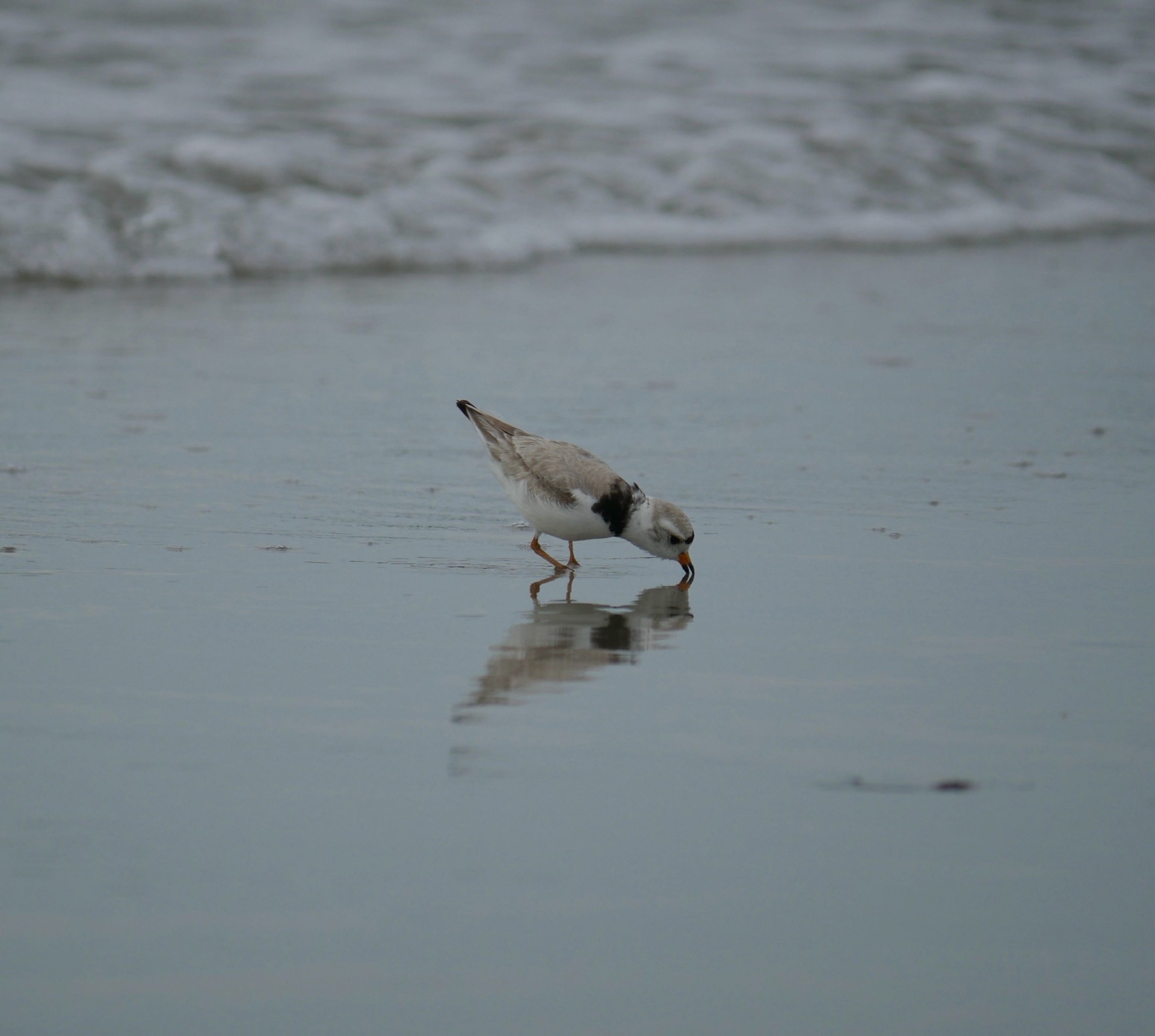
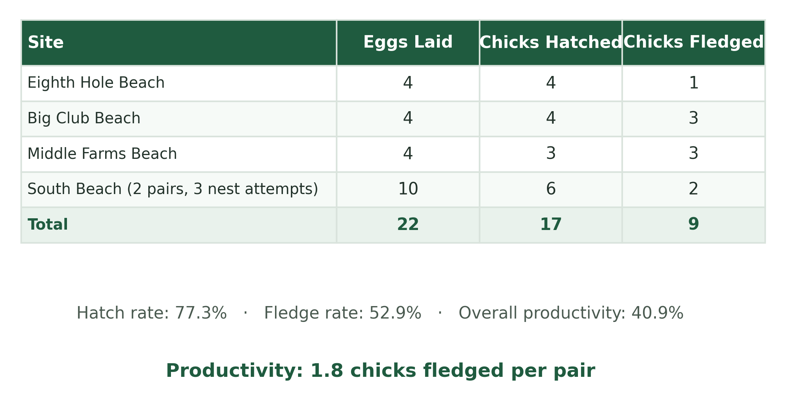
Another shorebird season has come to a close on island, and what a season it was! Across our 4 monitored sites, Eighth Hole Beach, Big Club Beach, Middle Farms Beach, and South Beach, we tracked 17 Piping Plover chicks hatched this year, with 9 successfully fledged, plus a wonderful Least Tern season at South Beach that added 5 more fledged chicks on top of that. It was a season of real highs and real challenges, and we wanted to share a look at both…
The Good News
Big Club Beach gave us one of the best stories of the year! After 0 plover nesting activity in 2025, this year a pair returned, hatched 4 chicks, and fledged 3 of them! A big part of that turnaround came down to where they chose to nest. The pair set up right behind a large, washed-up buoy on the site, which gave the family real physical protection from the sand grating equipment that runs regularly at the beach club. That buoy essentially acted as a natural barrier, allowing for less disturbance while the pair incubated their eggs. Once the chicks hatched, they were repeatedly pushed from one end of the site to the other by the raking. We were thrilled that these chicks managed to survive at all, given that their primary food source, which typically comes from the wrack line, was being removed on a daily basis. What we did see as a result of that disturbance was a notably late fledging date, these chicks didn’t fledge until around 38 days old, well beyond the typical 25 to 35 day fledging window for Piping Plovers. So much of their energy went toward repeatedly relocating away from equipment, which, combined with reduced food availability, slowed their growth and delayed the strength needed to fly. Still, watching this site bounce back from nothing to a thriving family was genuinely exciting, and it’s a clear example of how much a little natural cover can matter.
Middle Farms Beach (Secret Beach) had one of the cleanest seasons on the island. A single pair hatched 3 chicks from a full clutch of 4, and all 3 made it all the way to fledging with no documented losses the entire season. This site benefits from being naturally sheltered behind private property, with low foot traffic and minimal human disturbance, and it showed in the results. The one thing worth noting here was the surprising abundance of predators we documented throughout the season, coyotes, minks, and gulls all made appearances at various points. Despite that pressure, the pair still managed a completely successful season. Next year, we’d like to track the timeline of that predator activity more closely, to better understand how much of a role it may be playing even in a site with strong outcomes.
The Harder Stories
Eighth Hole Beach started strong, 4 chicks hatched from a full clutch, but this site always faces a real test around the 4th of July. Every year, a large crowd of boaters anchors and comes ashore here, mostly off-islanders drawn in by the beautiful sand, clear water, fewer gulls, and quieter feel compared to other spots. For the holiday weekend, we had FIRST members, our intern, and our Field Director out there talking with beachgoers, walking them through why the fencing was up, even the folks with dogs off leash. Most people were genuinely receptive once we explained it, a lot of them just hadn’t understood what the fencing meant in the first place.
Naomi Zahn and Natalie Sato from FIRST, along with our Field Director Anna, camped out at the site all day on the 4th, putting up temporary signage and checking in regularly all weekend to keep tabs on the chicks. The family was clearly stressed, but we were able to nudge beachgoers toward giving them space off to the side near the wrack line, where they seemed to settle down a bit.
Even with all that effort, the chicks still had a rough go of it. A multi-day rain event likely took one, and a volunteer directly witnessed a mink harassing the brood, leading to a confirmed predation loss. A third chick’s fate was never resolved, it simply disappeared between visits. By the end, only 1 chick from this site is believed to have successfully fledged. It’s a hard reminder of just how fragile these little guys are, even with a full team out there doing everything right.
South Beach has always been one of our most important sites, thanks to its exceptional habitat and heavy wrack line, but this year it was also, by far, our most challenging. Two separate Piping Plover pairs nested here, along with three Least Tern nests over the course of the season, and while the terns thrived, our plovers had a hard year. The site’s original pair lost their entire first brood of 3 chicks within a day of hatching in early June, almost certainly due to disturbance. That pair went on to attempt a second nest, which is worth sitting with for a moment: this shouldn’t have been necessary. South Beach has one of the healthiest, most food-rich wrack lines on the island, food scarcity was never the issue here. If anything, a site with this much natural food availability should be producing some of our fastest fledge times, not requiring birds to renest after losing their first brood.
The renest ran into further trouble along the way. In an effort to help protect the second nest and make it easier for our team to monitor, we marked it with pink flagging along the border of the symbolic fencing. In hindsight, this likely did more harm than good, the flagging seems to have drawn additional attention from beachgoers rather than deterring it, and we found heavy, concentrated footprints directly around that nest consistent with people standing right over it. Shortly after, the pair stopped incubating their two remaining eggs, and those eggs were ultimately lost to suspected abandonment. That renest’s surviving chick didn’t fledge until early August, which is remarkably late for the season. Under normal conditions, Piping Plover chicks typically fledge within 25 to 35 days of hatching, but the constant disturbance at this site clearly pushed that timeline out much further than it should have taken.
Disturbance from off-leash dogs was a recurring, serious issue at this site all season. Alongside our own in-person observations, we had trail cameras posted at South Beach this season, and the footage backed up exactly what we were seeing on the ground. Off-leash dogs were captured on camera at this site nearly 30 separate times over the course of the season, including instances of dogs entering the fenced nesting area directly and sniffing right at a nest marked with flagging. In one clip, a camera even captured a dog actively chasing a Piping Plover.
That said, it wouldn’t be fair to put this entirely on dogs. Our cameras also documented coyotes at the site on 7 separate occasions, including one sighting directly beside a Least Tern nest. So while off-leash dogs were clearly the most frequent and persistent disturbance we captured, wildlife predators were part of the picture at this site too, and it’s a good reminder that protecting these nests means accounting for more than just one kind of threat.
By the end of the season, South Beach’s two plover pairs together fledged 2 chicks from 6 hatched. It’s a real reminder of how much both human behavior and natural predator pressure can shape outcomes at a site like this.
The Least Terns, on the other hand, had a fantastic season at South Beach. Between the two originally tracked pairs and a third nest we discovered partway through, this site produced 5 fledged tern chicks, the best tern outcome of any site this year. Their persistent, aggressive territorial defense against beachgoers likely gave them an edge the plovers didn’t have.
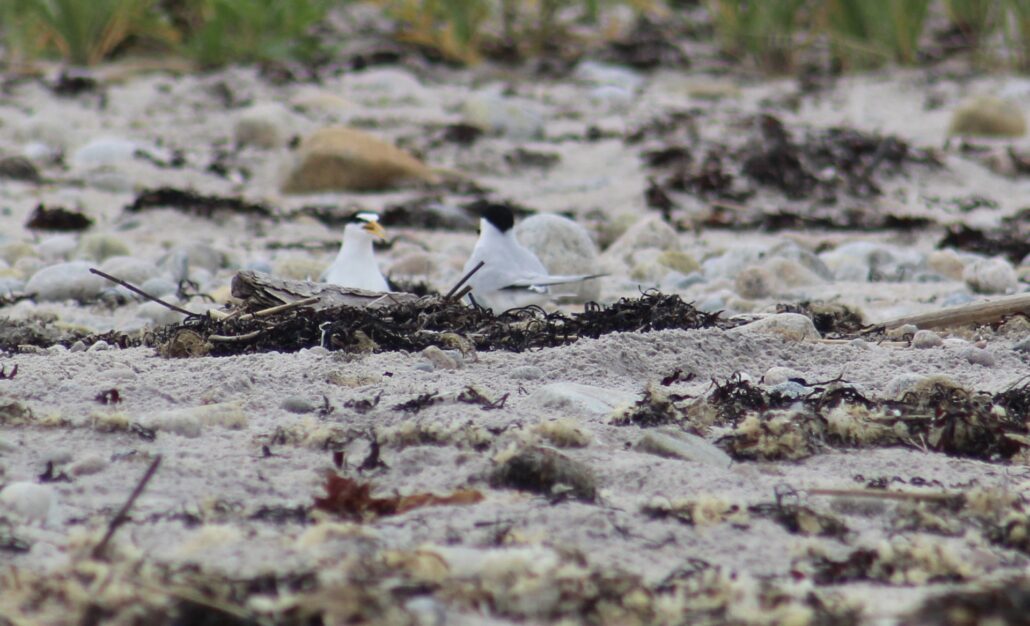
By the Numbers: 2026 Season Totals
Looking Ahead to 2027
This season’s data is going to directly shape how we approach next year. We’re looking closely at ways to better protect nests without accidentally drawing more human attention to them, given what happened with the flagging at South Beach. We’re exploring predator exclosures given the mink activity we documented at multiple sites this year. And we’re leaning much harder into community education around keeping dogs leashed during nesting season, especially at South Beach, where the habitat is genuinely ideal and human disturbance is really the only thing standing between this site and a great season.
Thank you to everyone who gave these birds space this year, whether that meant walking a different stretch of beach, keeping a pup on leash, or simply taking a moment to read one of our signs. We’ll see you again next spring for another season of watching these incredible birds raise their families right here on Fishers Island.